April 23, 2026 • Margot Calloway • 9 min reading time • Prices verified June 4, 2026
All-Season, Medium-Warmth, and Winter Labels: What Comforter Warmth Ratings Actually Mean
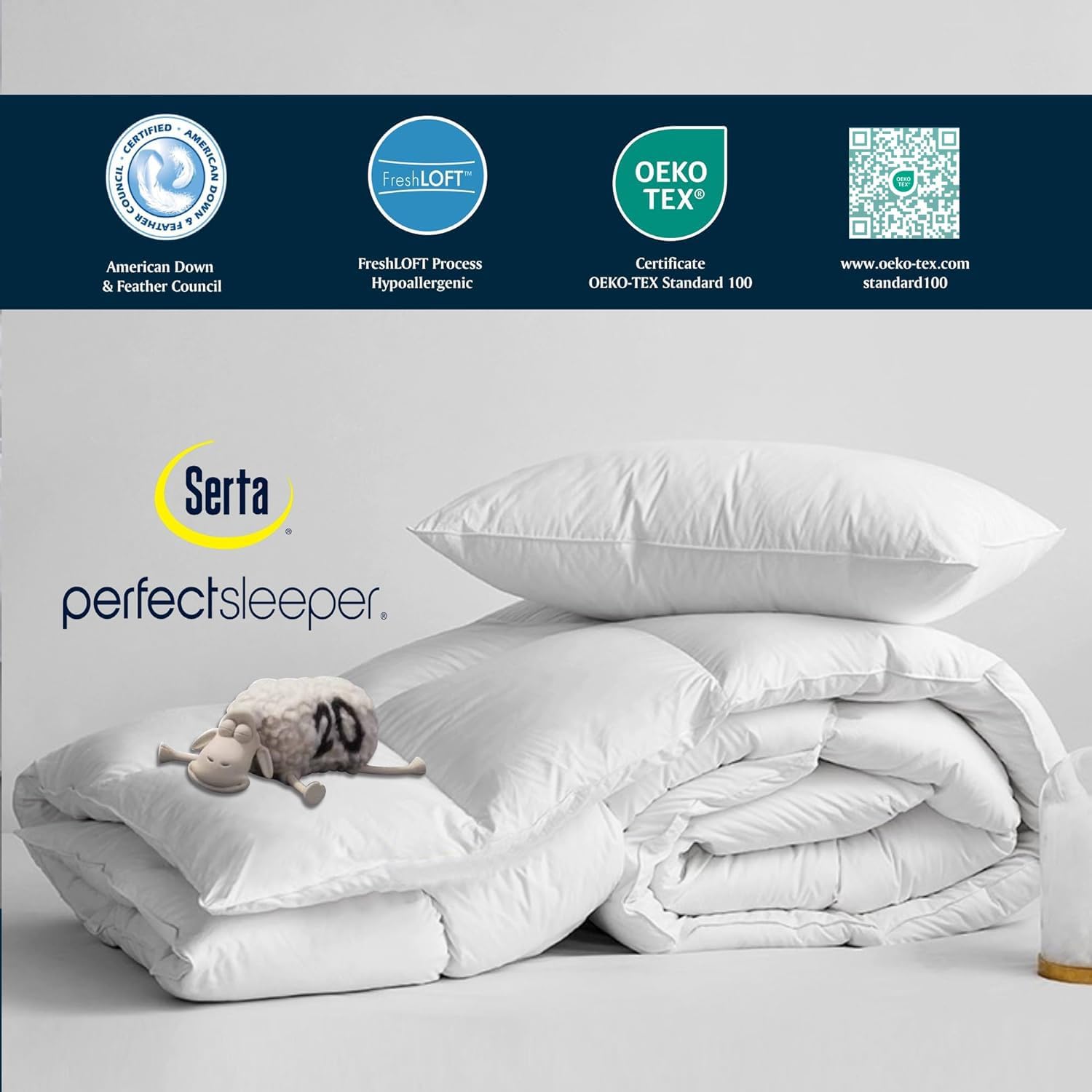
If you’ve ever stood in front of a bedding wall — or scrolled past three pages of Amazon listings — and wondered why one comforter is called “all-season” while another nearly identical product is labeled “medium warmth,” you’re not missing some industry standard. There isn’t one. Those warmth labels are marketing language, not a regulated spec. They don’t map to a shared scale across brands, and two comforters both calling themselves “all-season” can behave very differently under the sheets. What does follow consistent logic are the underlying numbers: fill power (how lofty and insulating an ounce of down is — higher means warmer per ounce) and fill weight (how many total ounces of down are actually inside the comforter). Together, those two figures determine how warm a comforter actually sleeps. This article is about learning to read past the warmth label to the numbers underneath — and then mapping those numbers to your specific bedroom, your body, and your budget.
| EDITOR'S PICK[puredown® Goose Down Comforter](https://www.amazon.com/dp/B09P9W76D6?tag=greenflower20-20)… | Mid-tier[Serta Goose Feather Down Fiber](https://www.amazon.com/dp/B082YL5ZT1?tag=greenflower20-20)… | Budget pick[Martha Stewart White Goose King](https://www.amazon.com/dp/B0GK8MQZ9Z?tag=greenflower20-20)… | |
|---|---|---|---|
| Fill Type | Goose Down | Goose Feather Down Fiber | Goose Feathers Down Fiber |
| Fill Power | 800 | — | — |
| Thread Count | 700 | — | — |
| Warmth Level | Winter/Extra Warmth | Light Warmth | Light Warmth |
| Oversized | ✓ | — | — |
| Weight | — | — | 59oz |
| Price | $436.99 | $85.79 | $66.56 |
| See on Amazon → | See on Amazon → | See on Amazon → |
Why Warmth Labels Are Unreliable (And What to Look For Instead)
Here’s the core problem: “all-season,” “medium,” “lightweight,” and “winter” are terms each brand defines on its own. Brooklinen’s all-season and Sferra’s all-season are not calibrated to each other. Neither is regulated by ASTM, ISO, or any bedding standards body. The Spruce’s guide to down comforter ratings makes this explicit, noting that fill power is the only number that carries a consistent, industry-wide definition — a lab measurement of how many cubic inches one ounce of down occupies when allowed to loft freely.
What you actually need to track is the combination of fill power and fill weight. Think of it this way:
- Fill power tells you the quality of the insulation — how efficiently each ounce traps warmth.
- Fill weight tells you the quantity of insulation — how many ounces are doing that work.
A comforter with 800 fill power and 18 ounces of down (for a queen) will sleep dramatically warmer than one with 800 fill power and 12 ounces — even if both are labeled “all-season” on their respective websites. Real Simple’s explainer on down comforters flags exactly this confusion, noting that shoppers who skip past the fill weight field frequently end up with a product that doesn’t match their warmth expectation.
By the Numbers: Typical Fill Weight Ranges by Warmth Category (Queen Size)
| Warmth Label | Typical Fill Weight (Queen) | Common Fill Power Range |
|---|---|---|
| Lightweight / Summer | 10–14 oz | 550–700 |
| All-Season / Medium | 14–20 oz | 600–800 |
| Warm / Winter | 20–28 oz | 650–850 |
| Extra Warm / Ultra Winter | 28+ oz | 700–900+ |
These are synthesized ranges drawn from published specs across Downlite’s product education resources, Wirecutter’s comforter research, and manufacturer spec sheets from Parachute, Brooklinen, and Sferra. Individual products vary.
How Fill Power and Fill Weight Work Together (The Math You Actually Need)
Downlite’s published fill power education resource offers one of the clearest frameworks: fill power tells you the efficiency of the insulation, and fill weight tells you the volume of it. You need both numbers to predict warmth.
Here’s the practical decision frame:
High fill power + low fill weight = lightweight luxury. This is the signature of premium summer or “lightweight” comforters. An 800-fill-power comforter stuffed with only 13 ounces of down will be remarkably lofty for its weight and feel whisper-light — but it won’t keep a cold sleeper warm in a 65°F room. This is the category where Hungarian and Polish goose-down products from Sferra and Matouk tend to live when configured as “summer weight.” The down is exceptional; there’s just less of it by design.
Moderate fill power + higher fill weight = the workhorse all-season. This is where the bulk of the mid-market lives. A 650-fill-power comforter with 20 ounces of down will sleep warmer than an 800-fill-power comforter with 13 ounces — the quantity advantage outweighs the quality difference at that gap. Brooklinen’s Luxe Comforter and Parachute’s Down Comforter in their all-season configurations tend to sit in this zone, and it’s the reason they earn such strong reviews from sleepers who keep their rooms in the 67–70°F range.
High fill power + high fill weight = true winter warmth. This is the premium winter tier — 750+ fill power with 24+ ounces for a queen. It’s genuinely heavy on the body and runs hot for warm sleepers. The Sleep Foundation’s best down comforter roundup notes that hot sleepers frequently size down from winter to all-season configurations after one winter of overheating, even with temperature-regulating sheets underneath.
The decision rule: start with your typical sleeping temperature, then use fill weight as your primary warmth lever. Fill power is a quality and value multiplier — higher fill power means the same warmth at lower weight and bulk — but fill weight is the warmth driver.
Mapping Warmth Labels to Real-World Sleep Scenarios
Now the practitioner translation: given that warmth labels are soft, here’s how to read them against the scenarios you’re actually making decisions for.
For Your Own Bedroom
The Sleep Foundation recommends most sleepers start by identifying their room temperature and sleep-style profile. A warm sleeper in a room that stays above 68°F year-round is almost certainly better served by a true lightweight or a lower-fill-weight all-season — not the product labeled “all-season” that’s actually packed to 22 ounces. A cold sleeper in a poorly insulated apartment in a northern climate where the room drops to 62°F in January needs actual fill weight, not just a high fill power number with a “winter” label.
Good Housekeeping’s down comforter testing team (which evaluates products against stated specs and aggregated owner feedback) consistently flags that brands in the $150–$400 tier tend to under-fill their “all-season” products relative to brands in the $400–$800 tier. The practical implication: an “all-season” from Casper or Beckham Hotel Collection may sleep more like a “lightweight” when placed alongside an “all-season” from Parachute or Buffy Pro.
For Boutique Hotels, Airbnbs, and Short-Term Rentals
This is the scenario where warmth-label ambiguity creates the most operational risk. If you’re outfitting six rooms and ordering based on label language rather than fill weight specs, you’re likely to end up with guest complaints that split between “too hot” and “too cold” — because the actual fill weights across a mixed order may vary by 6–10 ounces even within a single warmth-label tier from two different brands.
The practitioner approach: standardize on a single brand and fill weight spec for your property, then solve the “too warm / too cold” problem at the thermostat or with a layer option (a folded lightweight throw at the foot of the bed). Parachute Hotel Collection and Brooklinen Luxe both publish explicit fill weights in their spec tables — use those numbers, not the label, when building your linen budget.
Wirecutter’s comforter research notes that the all-season format (roughly 16–20 oz fill weight for a queen, 600–750 fill power) is the most defensible choice for hospitality settings because it accommodates the widest range of guest sleep profiles without running into the extremes.
For Layered-Bed Aesthetics (The Duvet-Plus-Layer Approach)
If your goal is a visually layered bed with a duvet insert plus a quilt or blanket, warmth stacking becomes part of the calculation. In this case, readers at Apartment Therapy consistently advise going one warmth tier lighter on the insert than you’d choose for standalone use — a lightweight or lower-end all-season insert layered under a wool or cotton blanket often outperforms a single heavy winter insert and reads better aesthetically.
The Certification Layer: What RDS and Downpass Tell You About Quality (Not Warmth)
One clarification that matters when reading spec sheets: certifications like RDS (Responsible Down Standard), Downpass, and IDFL verify that the down was sourced ethically — meaning no live-plucking and no force-feeding in the supply chain, verified by third-party audit. Responsibledown.org maintains the list of RDS-certified suppliers and license holders if you want to verify a brand’s claim directly.
These certifications say nothing about warmth. A comforter can be RDS-certified and still be underfilled for its label tier. Conversely, a non-certified product can hit excellent fill weight numbers. For ethics-conscious buyers, certification matters independently of warmth performance — but the two should be evaluated on separate tracks.
The If-Then Decision Framework
You’ve been reading spec sheets. Here’s how to close the loop.
If your room stays above 68°F year-round → target a fill weight under 16 oz (queen) regardless of what the label says. Ignore any “all-season” labeled product that doesn’t publish its fill weight — that opacity is usually a sign the number isn’t flattering.
If your room swings seasonally from 62°F to 72°F → a true all-season in the 16–20 oz range is the right call. Pair it with a lightweight layer for the coldest weeks rather than buying a separate winter insert.
If your room drops below 62°F in winter and you sleep cold → you need fill weights in the 22–28 oz range. A “winter” label with a published fill weight under 20 oz is mislabeled for your use case.
If you’re outfitting a rental property → standardize at 16–18 oz fill weight, 600–700 fill power minimum, from a brand that publishes both numbers. Budget tier: Brooklinen Luxe or Parachute Hotel Collection. Premium tier: Sferra or Matouk if the property positioning supports it.
If you sleep hot regardless of room temperature → treat fill weight as a ceiling, not a target. Look for brands that publish breathability data (shell thread count of 400 or below in a percale weave; baffle-box construction over sewn-through) — Real Simple’s down comforter guide notes that shell fabric and construction style affect perceived heat retention nearly as much as fill weight does for warm sleepers.
The warmth label is the last thing to read on a spec sheet. The fill weight and fill power are the first. Once you’ve built the habit of leading with the numbers, the label becomes background noise — and your next comforter purchase becomes a decision you can defend, not just a guess.