April 25, 2026 • Margot Calloway • 9 min reading time • Prices verified June 4, 2026
Lightweight Down Comforters for Hot Sleepers: Fill Weight Math and Cooling Shell Science
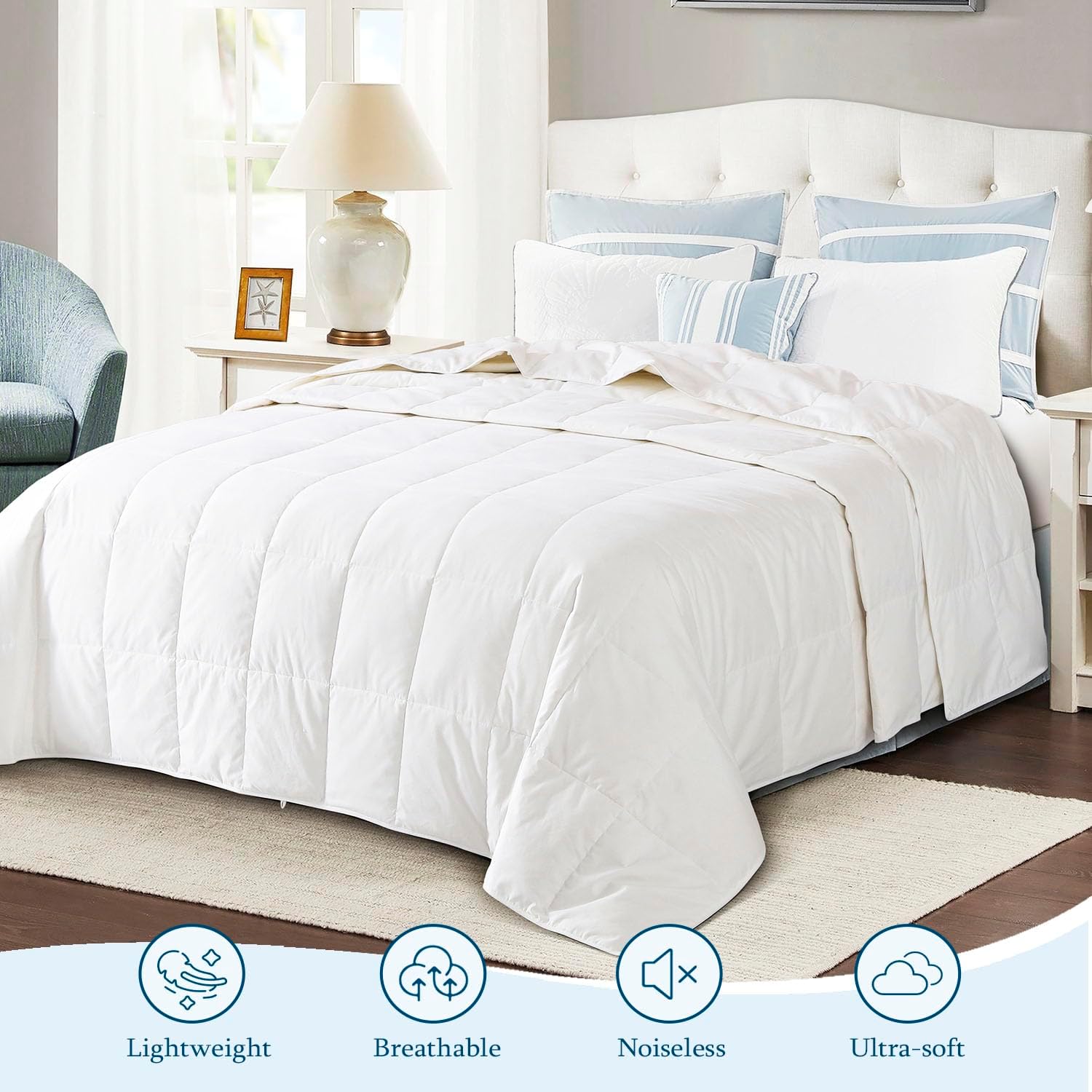
Down comforters have a reputation problem with hot sleepers. The word “down” conjures something heavy and smothering — the kind of thing you kick off at 2 a.m. But that reputation belongs to the wrong product. A well-chosen lightweight down comforter, built with a low fill weight (the actual ounces of down stuffed inside the shell) and a breathable shell fabric, can sleep cooler than most synthetic alternatives. The trick is knowing which two numbers actually matter: fill power (a measure of how much loft, or fluffiness, one ounce of down produces — higher means lighter for the same warmth) and fill weight (the total ounces of down in the finished comforter — lower means less insulation and cooler sleep). Most product listings show both. Most shoppers read neither. This guide will change that. By the end, you’ll have a clear decision rule for picking the right comforter if you’re a warm or hot sleeper, and you’ll know exactly which shell specs keep heat from building up overnight.
| EDITOR'S PICK[Olive + Crate Cooling Down Alte…](https://www.amazon.com/dp/B0CLLCX4MX?tag=greenflower20-20) | Mid-tier[Globon Summer Down Comforter Bl…](https://www.amazon.com/dp/B0DP42WQ2B?tag=greenflower20-20) | Budget pick[APSMILE Lightweight Feather Dow…](https://www.amazon.com/dp/B07SNRDBCK?tag=greenflower20-20) | |
|---|---|---|---|
| Fill type | Down alternative | Down | Feather down |
| Fill weight | — | 10 oz | — |
| Outer fabric | 100% Bamboo Viscose | — | 100% Organic Cotton |
| Quilted | — | — | ✓ |
| Size | King | Queen | Queen |
| Hypoallergenic | ✓ | — | — |
| Price | $119.99 | $119.99 | $79.90 |
| See on Amazon → | See on Amazon → | See on Amazon → |
Why Fill Weight Is the Number That Actually Determines Warmth
Fill power gets most of the marketing real estate, and that’s a problem. Fill power — typically ranging from 550 to 900+ on quality down — tells you about efficiency: how much warmth per ounce. A 900-fill-power down cluster traps more air, and therefore more warmth, per ounce than a 600-fill cluster. That’s useful for loft and weight. But it doesn’t tell you how warm the comforter will actually sleep, because it says nothing about how many ounces of down are inside.
Fill weight is the dial that controls warmth output. A comforter stuffed with 20 oz. of 800-fill-power Hungarian goose down will sleep significantly hotter than one stuffed with 12 oz. of the same down, even though both carry the same prestige fill-power number.
For hot sleepers, the target fill weight for a queen-size comforter is generally 12–18 oz. for a summer or lightweight option, versus 22–32 oz. for an all-season fill and 35+ oz. for a winter fill. Wirecutter’s 2025 down comforter review confirms this framing, describing lightweight options as suited to “warm sleepers or those in climates that don’t dip below 65°F overnight.” The Sleep Foundation’s 2025 cooling comforter guide draws the same line, noting that fill weights below 20 oz. in a queen are the standard threshold for “cooling” or “summer” comforter categories.
The math that matters:
| Warmth Category | Queen Fill Weight (approx.) | Best For |
|---|---|---|
| Summer / Lightweight | 12–18 oz. | Hot sleepers, warm climates, 65°F+ rooms |
| All-Season | 20–28 oz. | Most sleepers, climate-controlled bedrooms |
| Winter / Heavyweight | 30–40 oz. | Cold sleepers, unheated rooms, below 60°F |
The takeaway: when a brand lists a comforter as “lightweight,” verify the fill weight in the product specs. If it isn’t disclosed — a red flag in itself — compare the TOG rating if listed (a TOG of 4–7 maps to summer weight; 10–13 maps to winter).
High fill power does help hot sleepers in one indirect way: higher-fill-power down achieves the same insulation at a lower fill weight, meaning the finished comforter is lighter and loftier without excess bulk. That’s why a 14 oz. / 850-fill-power comforter from Sferra or Matouk can feel airier than a 14 oz. / 600-fill option, even at identical warmth output. Apartment Therapy’s 2024 explainer on fill power makes this point cleanly: “Fill power is about the efficiency of the down; fill weight is about the dose. You need to read both.”
Shell Science: What Fabric Actually Does for Heat Dissipation
Fill weight controls how much warmth is generated. Shell fabric controls how well that warmth escapes — or doesn’t.
A down comforter shell has two jobs: contain the down clusters so they don’t poke through, and allow air exchange so moisture and heat can dissipate. Those two goals are in mild tension, which is why shell fabric selection is a real engineering trade-off, not just an aesthetic one.
Thread count: Higher thread count (TC) in a cotton shell means a tighter weave, which is better at containing fine down clusters but worse at breathability. A 300 TC shell breathes better than a 500 TC shell, all else equal. For hot sleepers, look for shells in the 230–400 TC range in a quality long-staple cotton (Egyptian, Pima, or Supima). Good Housekeeping’s 2025 down comforter review specifically calls out 300–400 TC cotton percale shells as the “sweet spot for hot sleepers” who still want down containment without the suffocating density of a sateen weave.
Weave type matters more than thread count alone:
- Percale (a plain, one-over-one-under weave): crisp, matte, cooler feel, better airflow. The standard recommendation for hot sleepers.
- Sateen (a four-over-one-under weave): silky, lustrous, warmer drape, retains more heat against the skin. Better for cold sleepers.
- Cambric: a tight, smooth plain-weave cotton historically used in premium European down products. Breathes reasonably well but runs denser than percale.
Down-proof treatment vs. weave density: Some manufacturers achieve down containment through chemical down-proof treatments rather than tight weave density alone. This allows them to use a lower thread count (and therefore more breathable) shell while still preventing cluster migration. Brands like Parachute and Brooklinen use this approach on their lighter comforters. Check whether “down-proof” is achieved via weave or treatment — neither is inherently superior, but treated shells at lower TC tend to be more breathable.
Shell material alternatives:
- Lyocell / TENCEL™: moisture-wicking, temperature-regulating, increasingly used in cooling-focused shells. The Sleep Foundation notes TENCEL-blend shells as a strong option for “moisture-sensitive or warm sleepers.”
- Cotton-linen blends: more texture and airflow than pure cotton, though less common at the premium tier.
- Synthetic cooling shells: Some brands (Buffy, Casper) offer down-alternative or down-blend comforters with proprietary “cooling fiber” shells — worth considering if breathability is the primary constraint, though pure-down enthusiasts generally find the cluster loft superior.
Certifications and Why They Still Matter for Lightweight Picks
Buying lightweight doesn’t mean buying less carefully. Certification scrutiny is, if anything, more important when shopping summer-weight down, because lighter fill weights are sometimes achieved by blending lower-quality clusters or undisclosed down types.
The Responsible Down Standard (RDS), administered by Textile Exchange and documented in the RDS 3.0 standard, is the baseline certification to look for. It tracks the down supply chain from farm to finished product, verifying that birds were not live-plucked or force-fed. The IDFL (International Down and Feather Laboratory) provides third-party testing that verifies fill power claims — a 750-fill-power declaration backed by IDFL certification means an independent lab confirmed it. Downpass is the European equivalent, common on products from Sferra, Frette, and other brands sourcing Polish or Hungarian white goose down.
For hot sleepers shopping the premium tier ($400–$1,000+), Sferra’s Brun and Arcadia lightweight comforters carry IDFL-certified fill power and RDS-compliant sourcing, with cambric cotton shells in the 300–350 TC range — breathable enough for warm sleepers while maintaining the heirloom construction. Matouk’s Montreux Summer Weight uses a percale shell with certified Hungarian white goose down, explicitly positioned for warm-room use. At the mid-tier ($200–$450), Parachute’s Hotel Comforter in lightweight uses an RDS-certified fill in a percale shell; Brooklinen’s Down Comforter in Summer Warmth is similarly configured. Both are well-documented in aggregated owner reviews for sleeping notably cooler than all-season fills.
The Decision Framework: If X, Then Y
If you’ve made it this far, you have the variables. Here’s how to collapse them into a choice.
If your bedroom stays above 68°F year-round (or you run warm regardless of room temp): Choose a summer-weight fill: queen fill weight ≤ 16 oz., shell in percale or TENCEL-blend at 230–380 TC. Budget-tier: Beckham Hotel Collection’s lightweight option. Mid-tier: Brooklinen Summer Weight or Parachute Lightweight. Premium: Matouk Montreux Summer or Sferra Arcadia Summer.
If your bedroom dips below 68°F seasonally but you still sleep hot: Choose an all-season fill (18–24 oz. queen) but prioritize a percale shell over sateen. You’ll adjust with layers (a linen duvet cover adds breathability; a waffle-weave blanket underneath replaces the comforter on the hottest nights). Brooklinen Luxe All-Season and Parachute Hotel Collection both hit this configuration.
If fill weight isn’t disclosed in the product listing: Walk away or email the brand before buying. A brand that won’t publish fill weight on a down comforter is either hiding an unimpressive spec or doesn’t understand its own product. Either way, it’s a signal.
If you’re torn between high fill power and low fill weight: Prioritize fill weight for warmth control; use fill power as a tiebreaker for loft and longevity. A 14 oz. / 700-fill comforter will sleep cooler than a 22 oz. / 850-fill comforter, every time, regardless of how good the marketing sounds.
If you’re at the premium tier and debating down vs. down-alternative for cooling: Published specs and aggregated owner reviews consistently show that high-fill-power natural down (600+), used at a low fill weight in a percale shell, outperforms most synthetic alternatives on breathability and moisture management over a full night. The Sleep Foundation’s 2025 guide notes that “natural down’s cluster structure allows more air circulation than most synthetic fill alternatives at equivalent warmth levels.” The exception: if you have a down allergy or strong ethical objections, responsibly sourced down alternatives from Buffy or Casper’s Pro tier are the next-best option.
A Final Word on Return Policies and Trial Periods
The cooling performance of any comforter is only verifiable in your actual sleep environment. Before you buy, confirm the return window: Parachute offers 60-day returns; Brooklinen offers 365-day returns on most bedding; Sferra and Matouk typically sell through retail partners (Bloomingdale’s, Saks) whose return windows vary by purchase method. DTC purchases from Sferra.com carry a 30-day return window. Buying through Bloomingdale’s or Saks during a sale event can get you a better per-unit price and a more flexible return policy — worth checking before committing at full MSRP.
The math on getting this right is simple: a $300 lightweight comforter that you actually sleep under for a decade is a better investment than a $150 all-season fill you kick off every night and eventually replace. Buy the right weight once, verify the shell, check the certification — and sleep through the summer.